
Residential outdoor education, complexity and interdisciplinary learning
Roger Scrutton discusses the case for IDL in residential outdoor education

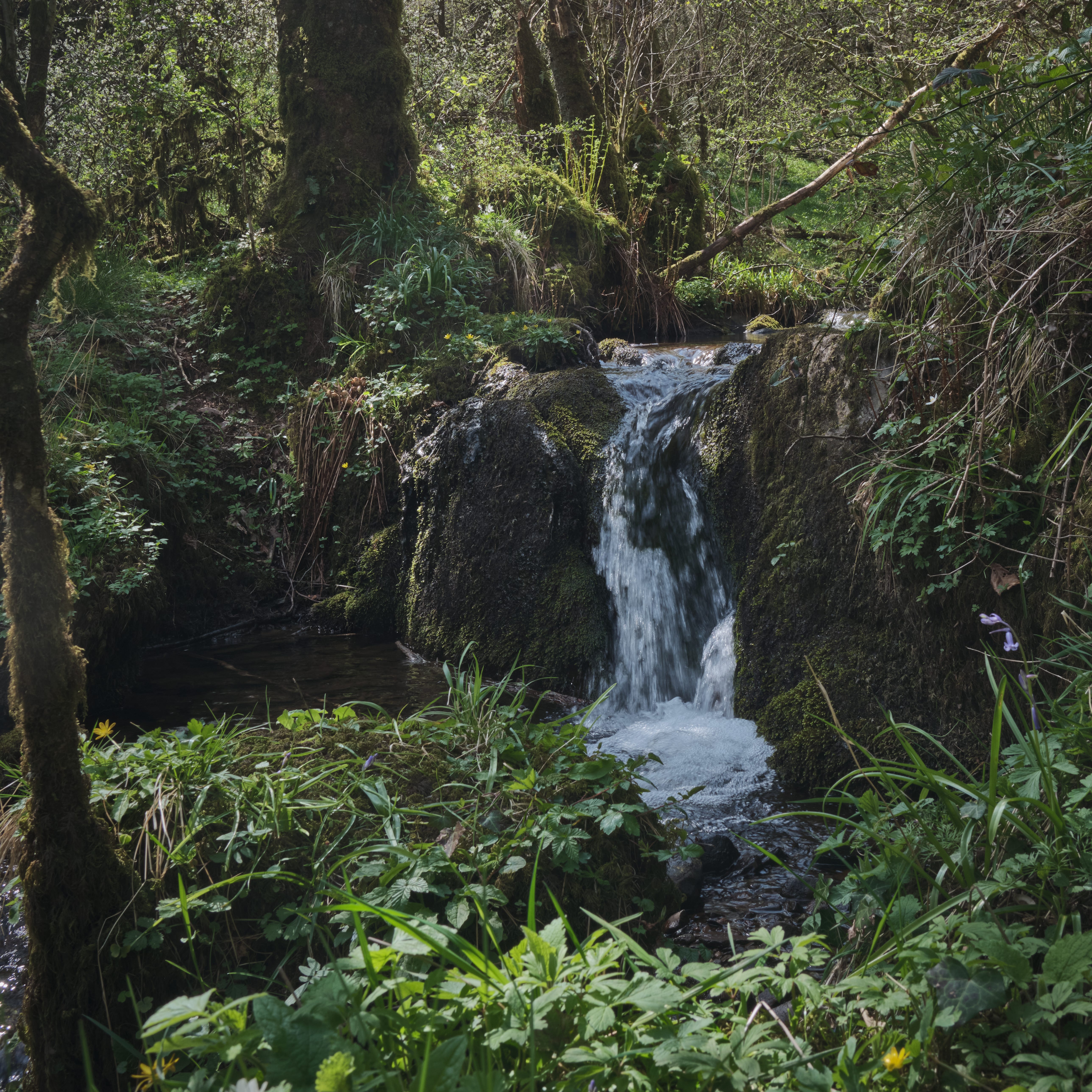
Residential outdoor education is characterised by its place, its activities, and its learning processes. It is located within the natural environment, usually some distance from the participating school, with traditionally adventurous outdoor activities, which may also be curriculum-related. Whilst the learning processes of residential outdoor learning are predominantly experiential, they have potential across all domains of learning.
The Scout movement was an early example of organised residential outdoor education, focusing on character building, but more recently outdoor education has been seen to enable the development of life skills. Such skills include social effectiveness, teamwork, resilience and problem solving, as well as the promotion of connectedness to nature, and health and wellbeing. It has recently been very much in the news in Scotland with the passing of the Schools Residential Outdoor Education Act by the Scottish Parliament in December 2025, which is expected to come into effect from 2027. Through this Act, all Scottish school pupils will be entitled to a 5-day long residential experience at some time during their years in school.
One of the most obvious aspects of education outdoors is that there is a lot going on
Complexity, in a nut shell, is ‘the state of having many parts and being difficult to understand or find an answer to’ (Cambridge Dictionary). Two significant but different cases have been made for the complexity of outdoor education. Firstly, in 2001, Higgins said, ‘One of the most obvious aspects of education outdoors is that … there is a lot going on’. Importantly, the ‘lot going on’ ranges across and between the affective, cognitive and psychomotor domains of learning, a process referred to as ‘intertwining’ by Krathwohl et al. It is an adventure, and by its very nature has an uncertain outcome. Higgins concluded that education outdoors is a complex learning process, encompassing social (soft) and scientific (hard) examples of complexity. He argued that it is an educational imperative to introduce pupils to the complexity of learning outdoors to complement the prescriptive and compartmentalised nature of the educational experiences of the day.
The second case for the complexity of outdoor education comes from Williams in 2013, who was concerned with the learning process during a residential adventure education course for primary pupils. He doesn’t refer to Higgins’ 2001 paper but adopts complexity theory following discussions with educationalists to throw light on the inter-relationships between different aspects of the residential experience. In summary, he concluded that pupils demonstrate emergence at the conclusion of a residential experience due to the complex interactions acting on them. Emergence is a phenomenon associated with complex systems, referring to a step change in growth (personal growth in this case) which emerges only when properties or behaviours interact with one another.
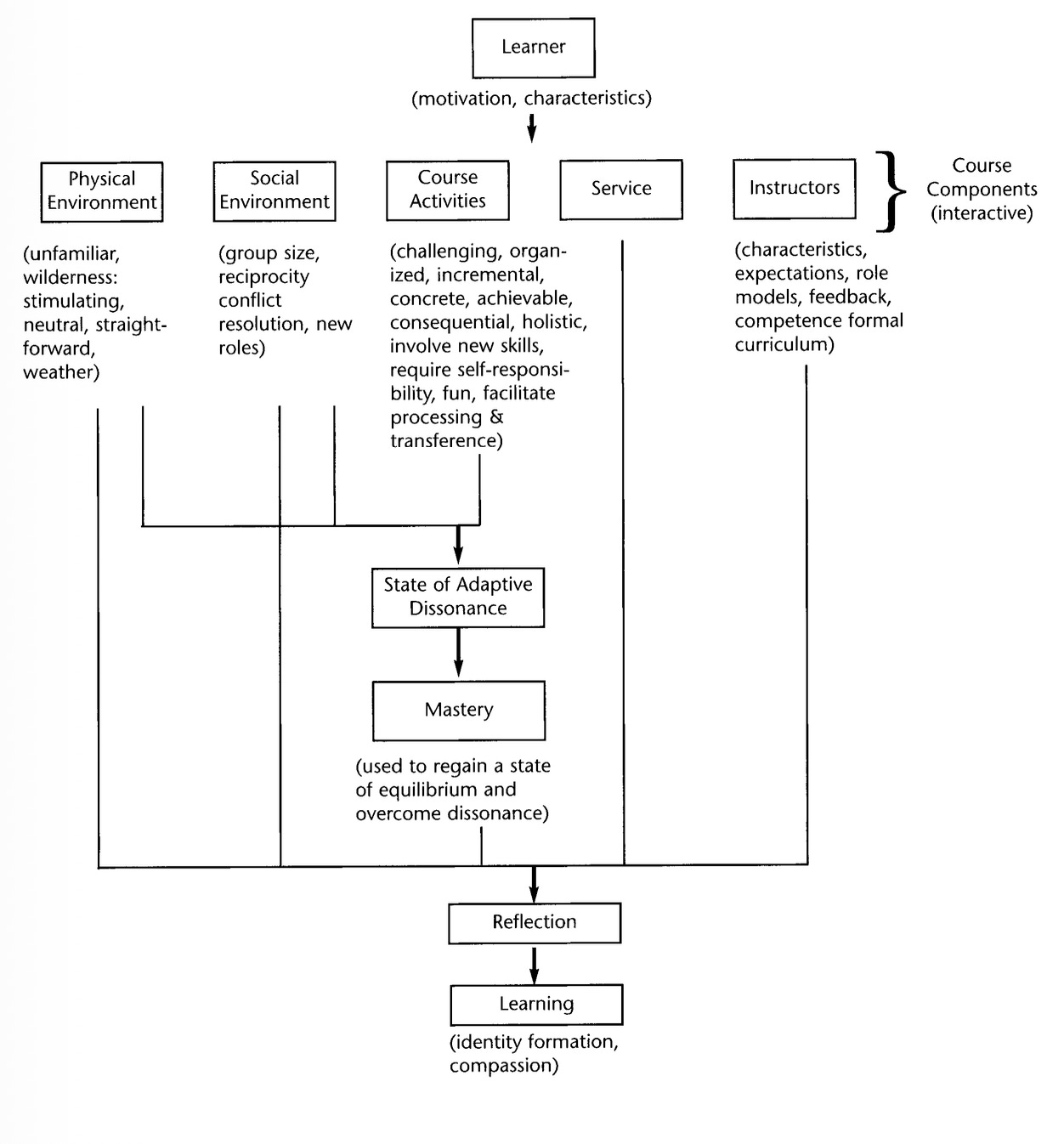
Williams made passing reference to a 2003 paper by McKenzie. This paper, on the learning process during Outward Bound courses, was too late for Higgins to take into consideration; but to my mind it is deserving of more than a passing reference because it presents the complex nature of residential adventure education graphically (see figure, below). The publication doesn’t refer to complexity at all, but it does make the point that course elements interact. The graphic doesn’t need much explanation. It includes the inputs to the complex process – the learner, the physical and social environments, course activities, service and instructors – and towards the bottom, reflection and the emergent learner. The involvement of instructors at a late stage in the process is misleading though, since outdoor instructors are teaching, encouraging, reviewing and reflecting with the learners throughout the residential experience.
Of these three research papers only Higgins 2001 referred explicitly to interdisciplinary learning, yet all the authors were aware of residential course components interacting on the learner during the learning process. However, other papers do refer. In 2012, Allison and co-authors, writing about Scotland, said, ‘It is arguable that outdoor learning, conceived in an interdisciplinary way, might well provide the kind of educationally meaningful links for which recent curriculum initiatives like Curriculum for Excellence have sought.’; and in 2024 Higgins said, ‘Education outdoors has long been a feature of Scottish education in school grounds, locally and at residential centres, and lends itself to practical, innovative interdisciplinary pedagogies’. Allison et al. made a passing reference to complexity to bemoan the fact that at their time of writing pupils had very limited appreciation of the importance of complex problem solving. However, in 2010 Learning and Teaching Scotland had already moved on this and said, ‘The introduction of Scottish Baccalaureates, particularly in Science, at Higher and Advanced Higher together with an interdisciplinary project will offer opportunities for the outdoors to be used as a context for learning.’
Learning in the outdoors is one of the four contexts for learning in the Scottish Curriculum for Excellence not least because it provides opportunities for personal development, and the development of life skills that bear on pupils’ motivations and attitudes towards learning.
Dr. Roger Scrutton has a background in geology and geophysics as a member of academic staff in the School of Geosciences at Edinburgh University from 1974. He is now an Honorary Research Fellow in the Outdoor Education Group at Edinburgh.
References
Allison, P., Carr, D., & Meldrum, G. (2012). Potential for excellence: interdisciplinary learning outdoors as a moral enterprise. Curriculum Journal, 23(1), 43-58.
Higgins, P. (2001). Learning outdoors: Encounters with complexity. Other ways of learning, 99-106.
Higgins, P. (2024). Nature’s classroom: Tackling the climate and nature crisis through Scottish schools. Resource, Royal Society of Edinburgh, Spring, 2024, 16.
Krathwohl, D.R., Bloom, B.S., & Masia, B.B. (1964). Taxonomy of educational objectives: The classification of educational goals. Handbook II: The affective domain. New York: David McKay.
Learning and Teaching Scotland (2010). Curriculum for excellence through outdoor learning. 28pp.
McKenzie, M., & University, S. F. (2003). Beyond “The Outward Bound process:” Rethinking Student Learning. Journal of Experiential Education, 26(1), 8-23.
Williams, R. (2013). Woven into the fabric of experience: Residential adventure education and complexity. Journal of Adventure Education & Outdoor Learning, 13(2), 107-124.